(Courtesy of the Library of Congress )

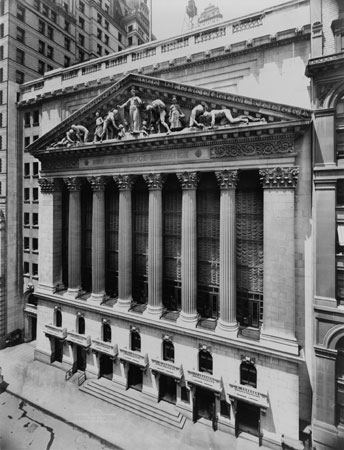
As the ferocity of his attack on the Exchange Act indicated, New York Stock Exchange president Richard Whitney considered any interference in his "perfect institution" to be a personal threat. Kennedy's appointment helped quell Whitney's concerns, however, and he worked often closely with the Chairman. Nevertheless, in fulfilling its statutory duty to report on the internal governance of the exchanges, the SEC helped put Whitney's job, if not his influence, in jeopardy.
The SEC began by issuing, in August 1934, thirteen requirements for the registration of exchanges, including the furnishing of statistical data on operations, provision of constitutions and bylaws, and a pledge to discipline members who did not abide by the Securities Exchange Act. Within a month, twenty-five exchanges had registered to be certified as a "national securities exchange."
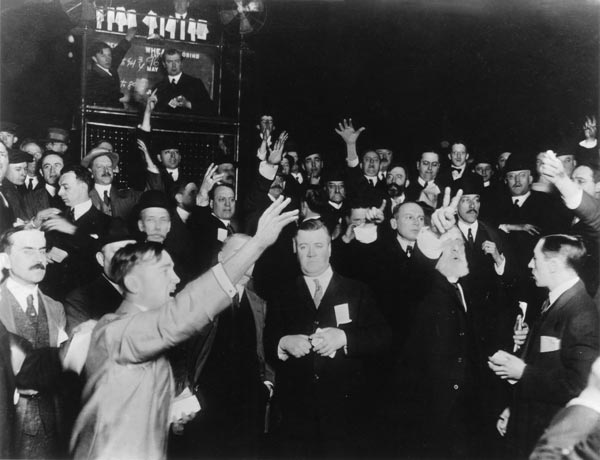
The threat to Whitney first appeared the next January when the Commission issued its report on the internal government of exchanges, which was directed almost entirely at the New York Stock Exchange. The SEC found that although commission brokers held 52 percent of the seats on the exchange, they accounted for only one-third of the governing committee. The New York Stock Exchange, the report said, was dominated by a small number of floor traders and specialists.
The SEC issued eleven recommendations intended to increase the influence of commission brokers and make the exchange more responsive to the public. None of these rules were mandatory, but Kennedy hoped that "in the main, these recommendations will be found acceptable and put into effect by the exchanges themselves." (Seligman, 119)
Whitney refuted the eleven points in an angry memo and challenged the SEC's right to interfere. Then a number of influential commission brokers publicly supported the SEC. Unlike specialists and floor traders, they had been hurt by the sharp decline in investment by a public that no longer trusted the market. The brokers, like the SEC, hoped that regulation would boost business by restoring faith.
Whitney backed down, the New York Stock Exchange adopted the recommendations, and the next month Whitney was defeated as president by commission broker Charles Gay. It was merely a symbolic victory, however; Gay turned out to be a weak and conservative administrator, and Whitney's "Old Guard" stayed in charge.