
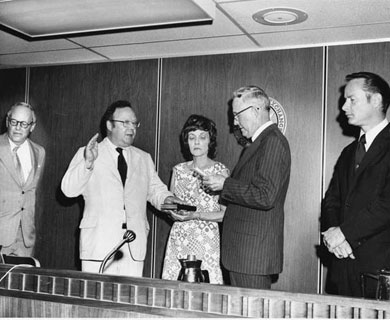
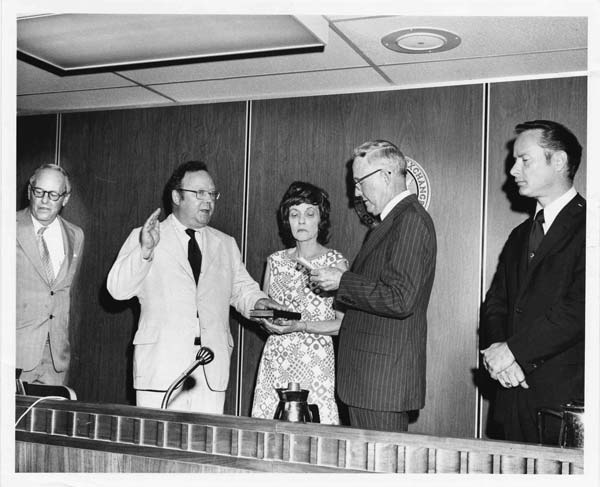
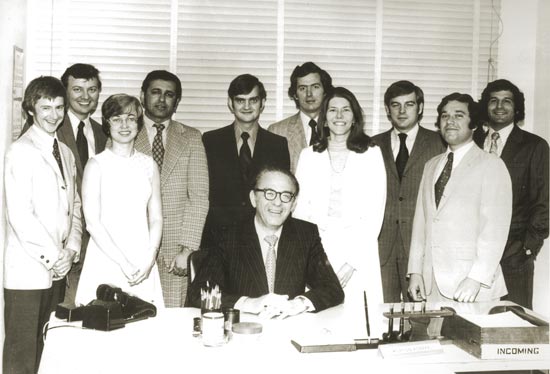
Philip A. Loomis, Jr., Ray Garrett, Jr., Virginia Garrett, Hugh Owens and John R. Evans
(Photo and identification courtesy of Nancy Garrett Worcester )

- September 4, 1973 Swearing-in ceremony for SEC Chairman Ray Garrett, Jr.
Philip A. Loomis, Jr., Ray Garrett, Jr., Virginia Garrett, Hugh Owens and John R. Evans
President Nixon's entanglement in the ethical crisis of Watergate, and the disclosure that the SEC Chairman G. Bradford Cook had perjured himself before Congress when testifying about the SEC's investigation into the illegal payment scandal involving financier Robert Vesco, created a crisis at the agency.(3) After Cook's resignation on May 17, 1973, Nixon calculated his response to criticism that he had politicized the agency by ending his previous practice of appointing political friends to the SEC.
Anxious to demonstrate that his administration could still attract top talent, Nixon offered the SEC Chairmanship to Ray Garrett, Jr., a conservative lawyer from Chicago who had remained aloof from politics.(4) Garrett had served in the SEC from 1954 to 1958, primarily in the Division of Corporate Regulation. In addition, he had served on several national advisory boards, including as a consultant to Professor Louis Loss's American Law Institute Federal Securities Codification project.(5)
Garrett declined the offer, recommending that Nixon appoint A. A. Sommer, Jr., a Cleveland attorney and securities bar expert. Nixon refused to appoint Sommer, who was a Democrat. When the term of SEC Commissioner A. Sydney Herlong ended in June 1973, a deal was reached whereby Garrett would become Chairman and Sommer would replace Herlong on the Commission.
Six months later, Nixon named Irving Pollack as his final Commission appointment. Pollack was a career SEC staff attorney who had served as both the Director of the Divisions of Enforcement and of Market Regulation, and who had played key roles in several ongoing issues, including that of fixed commission rates.
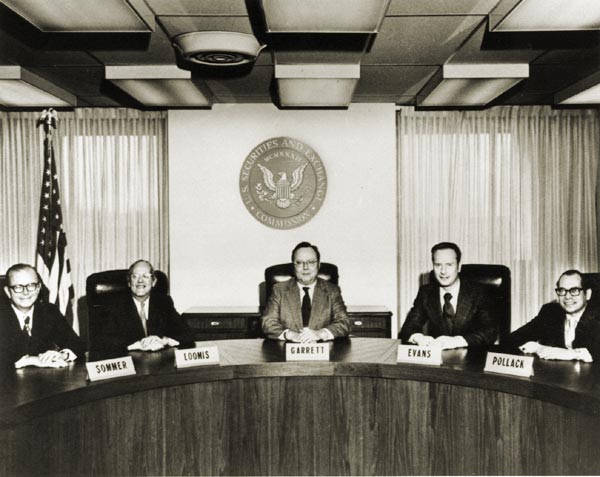
Garrett, Sommer and Pollack joined SEC Commissioners Philip Loomis and John R. Evans to form a SEC Commission that, even as Nixon's Presidency collapsed, provided competent and expert leadership that laid the foundation for successful policy implementation at the SEC.
(3) The Bright Image: The SEC, 1961-1973, Ethical Crisis at the SEC – Chairman Cook
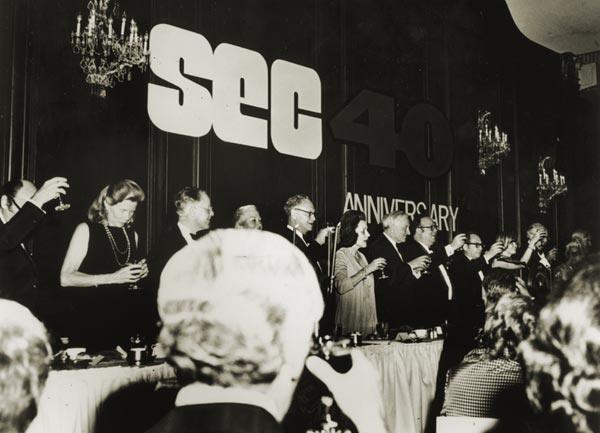
(4) Felix Belair, Jr., "S.E.C. at 40 Pushes Reform," The New York Times, June 30, 1974, 127
(5) Joel Seligman, The Transformation of Wall Street (Aspen Publishers: New York, 2003), 448-449
From 1968 to 1978, Harvey Pitt served on the staff of the SEC, eventually becoming the agency's youngest-ever General Counsel in 1975 at age 30. From 2001 - 2003 he was the 26th SEC Chairman. For nearly 25 years prior to serving as SEC Chairman, Mr. Pitt was a partner in the law firm, Fried, Frank LLP. After he left the SEC, he founded the strategic consulting firm, Kalorama Partners, LLC. He was a founding trustee and first President of the SEC Historical Society.