www.sechistorical.org

Virtual Museum and Archive of the History of Financial Regulation

SEC HISTORICAL SOCIETY

Galleries

431 Days: Joseph P. Kennedy and the Creation of the SEC

The Kennedy Legacy
Arc of Descent

Joseph Kennedy was prone to self-dramatization, and when he resigned the Chairmanship he announced that he would never return to public life. But by 1936 Kennedy was back in Washington to serve as an unofficial advisor to FDR, promoting the appointment of William O. Douglas to the SEC chairmanship. Kennedy also backed Roosevelt's reelection campaign, lending his name to the book I'm For Roosevelt .

In 1937 Kennedy became the first Chairman of the United States Maritime Commission. His job was to revitalize America's deteriorating commercial fleet and to broker peace with (and within) the tumultuous maritime unions. Although he did put the Maritime Commission on its feet, Kennedy failed to fulfill either objective. Whatever it took to mollify investment bankers did not work with longshoremen, and Kennedy clung too long to the idea of building up a fleet with private capital.

This mixed record continued after 1938 when Kennedy took the most prestigious and visible job of his career: U.S. ambassador to the Court of St. James in London. At first, Kennedy's brashness brought a breath of fresh air to stuffy old England. But Kennedy stayed too long and events overtook him. While Hitler took over Europe, Kennedy backed appeasement and American isolationism, although Roosevelt understood that America would inevitably fight. In the end, Roosevelt did something that he was famous for doing but had never done to Kennedy--he simply ignored him.

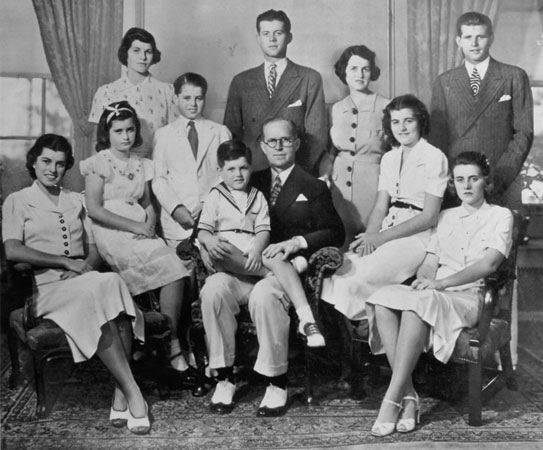
Before this arc of descent Kennedy had already realized important professional and personal goals. In 431 days at the Securities and Exchange Commission, he had reformed America's capital markets and become much more than a businessman. He had also made a name for his family and launched his son, John Fitzgerald Kennedy, toward the pinnacle of American political power. He gave America both the SEC and JFK, and it is worth considering that the former may be his more durable, if less heralded, legacy.

Late in life, when asked what drove his career, Kennedy admitted that "I wanted power. I thought money would give me power and so I made money, only to discover that it was politics--not money--that really gave a man power." (Beschloss, 266)

That was a lesson that the father would teach to his son, but it is telling that Joseph P. Kennedy's greatest achievement came when he worked through politics to save American business--a moment when those two warring Kennedy inclinations were in perfect equipoise.

<< Previous


Related Museum Resources
Papers
June 6, 1935
[transcript] (pdf) (with permission of the John F. Kennedy Library Foundation)
September 21, 1935
[transcript] (pdf) (with permission of the John F. Kennedy Library Foundation)
September 21, 1935
[image] (pdf) (with permission of the John F. Kennedy Library Foundation)
September 23, 1935
[transcript] (pdf) (Courtesy of the National Archives)
September 23, 1935
[transcript] (pdf) (with permission of the John F. Kennedy Library Foundation)
September 23, 1935
[image] (pdf) (with permission of the John F. Kennedy Library Foundation)
September 23, 1935
[transcript] (pdf) (Courtesy of the National Archives)
September 24, 1935
[document] (pdf) (with permission of the John F. Kennedy Library Foundation)
Photos
1938
(Courtesy of the Washington Evening Star Collection, Washingtoniana Division, D.C. Public Library )

Read More About It

Good scholarly and popular works on stock market speculation before and during the 1920s include: Cedric B. Cowing , Populists, Plungers, and Progressives: A Social History of Stock and Commodity Speculation, 1890-1936 (Princeton, 1965); John Brooks, Once in Golconda: A True Drama of Wall Street, 1920-1938 (New York, 1969); and Gordon Thomas and Max Morgan-Witts, The Day the Bubble Burst: The Social History of the Wall Street Crash of 1929 (New York, 1979).

For more on New Dealers and FDR's "Brain Trust" see: Katie Louchheim, The Making of the New Deal: The Insiders Speak (Cambridge, 1983); Joseph P. Lash, Dealers and Dreamers: A New Look at the New Deal (New York, 1988); Jordan A. Schwarz, The New Dealers: Power Politics in the Age of Roosevelt (New York, 1993); and Katie Louchheim, draft of unpublished manuscript, The Little Red House, Box 71, Folder 9, Katie S. Louchheim Papers, Manuscript Division, Library of Congress.

On the theoreticians of regulation see: Donald A. Ritchie, James Landis: Dean of Regulators (Cambridge, 1980); Michael E. Parrish, Felix Frankfurter and His Time: The Reform Years (New York, 1982); Thomas K. McCraw, Prophets of Regulation (Cambridge, 1984); and Philippa Strum, Louis D. Brandeis: Justice for the People (New York, 1984).

Useful insider accounts include: Raymond Moley, After Seven Years: Franklin D. Roosevelt and the Era of the New Deal (New York, 1939); Harold Ickes , The Secret Diary of Harold L. Ickes: The First Thousand Days, 1933-1936 (New York, 1953); and Moley, The First New Deal (New York, 1966).

Joseph P. Kennedy has had both fairly sympathetic and overtly hostile biographers. An example of the former is David E. Koskoff, Joseph P. Kennedy: A Life and Times (Englewood Cliffs, New Jersey, 1974); the latter includes Ronald Kessler, The Sins of the Father: Joseph P. Kennedy and the Dynasty He Founded (New York, 1996). Amanda Smith, Hostage to Fortune: The Letters of Joseph P. Kennedy (New York, 2001), is a valuable collection of correspondence compiled by a family insider. Of particular interest is Michael Beschloss, Kennedy and Roosevelt: An Uneasy Alliance (New York, 1980).

On the history of the SEC and securities regulation in the New Deal see: Ralph E. De Bedts, The New Deal's SEC: The Formative Years (New York, 1964); Michael E. Parrish, Securities Regulation and the New Deal (New Haven, 1970); and Joel Seligman, The Transformation of Wall Street: A History of the Securities and Exchange Commission and Modern Corporate Finance (Boston, 1982).


Special Thanks

The development of this gallery was made possible, in part, through the support of the Joseph P. Kennedy, Jr. Foundation.

The Securities and Exchange Commission Historical Society is grateful to Daniel R. Ernst, Professor of Law, Georgetown University Law Center, and to Richard H. Rowe, Proskauer Rose LLP, for their contributions to the development of this gallery.

(copyright) 2002-2010 Securities and Exchange Commission Historical Society

Terms of Use | Privacy Policy