(Courtesy of the Library of Congress )

Kennedy's SEC was circumspect about enforcement, perhaps to allow time for honest traders to adjust to the new regime. No proceedings were brought against the New York Stock Exchange during his entire tenure. Nevertheless, the SEC did act when particular individuals, perpetrators of fraudulent stock schemes, and curb exchanges crossed the line.
The biggest fish that the Commission went after was Michael Meehan, the leader of the Radio Pool and a friend of Joseph Kennedy's. In 1935 the SEC began proceedings against Meehan for manipulating the price of Bellanca Aircraft stock, and he was ultimately barred from trading on the New York Stock Exchange and other exchanges.
More typical were the cases of fraud. One involved a company that sold "endowment bonds" to unsuspecting school teachers. A look at the firm's registration statement convinced the SEC to hand down a "stop order" halting the issue. Investigators then learned that the firm was insolvent, with a $5,000 reserve to cover $53,000 in liabilities. The SEC kept about $20 million in fraudulent issues off the market during Kennedy's tenure.
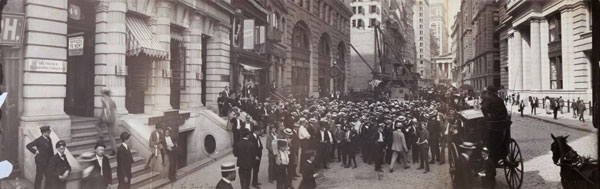
"Curb exchanges" were particularly problematic. These usually began informally with traders doing business literally on the curb outside a formal exchange. While the largest exchanges usually conducted some self-policing that increased as regulation drew imminent, smaller local institutions and curb exchanges retained some dubious practices.
SEC investigators, therefore, fanned out to investigate these institutions. As a result, a number of curb exchanges were merged into other exchanges. Four institutions--the California Stock Exchange, The Hartford Stock Exchange, the Philippine Stock Exchange, and the Curb Exchange in Kennedy's hometown of Boston--were shut down. The New York Produce Exchange stopped issuing securities altogether, and the New York Mining Exchange, long known for fleecing low-income customers, closed its doors.
The SEC also negotiated with federal and state officials to set up a national clearinghouse for information on securities violators, which went into operation in May 1935. Although prosecution was not a priority, the SEC's early record was respectable. During its first year the Commission investigated more than 2,300 cases. Thirty of these were turned over to the Justice Department, one involving the well-known investment firm of J. Edward Jones.