
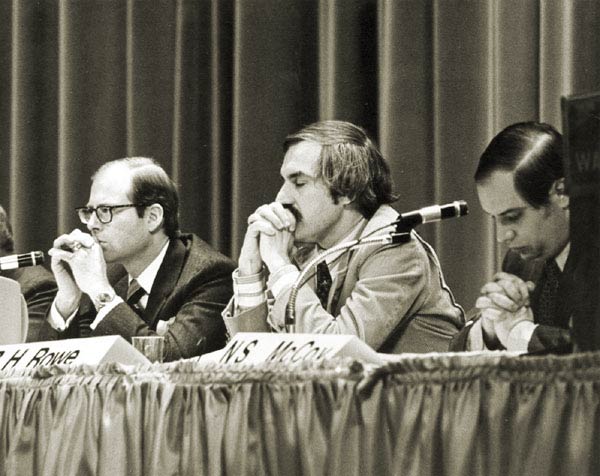
Andrew Steffan, Chief Financial Analyst; Richard Rowe, Associate Director; Neal McCoy, Chief Counsel.
(Courtesy of Richard Rowe )

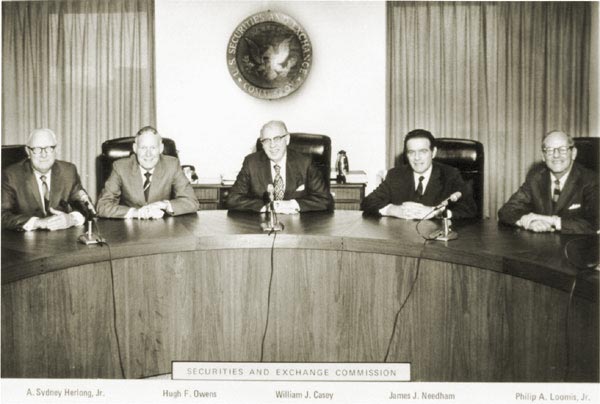
While Budge's appointment proved controversial, President Nixon's next appointee as SEC Chairman appeared at first glance to be even more so. William J. Casey succeeded Hamer Budge in April 1971 and served until February 1973. Casey was a prominent New York trial lawyer and a leading authority on tax law, with limited experience in securities matters.
There were growing political concerns about the ability and effectiveness of the SEC as an independent regulatory agency, and the political nature of Casey's appointment did little to assuage critics. President Nixon paid close attention to the stock market as a measure of his political fortunes. He wanted to assure leaders of the business and securities community that his administration was actively pursing reasonable solutions to the problems they faced.
At his confirmation hearing, Casey told the Senate Banking Committee that he approached the job "without any preconceptions. I come here with an open mind. I don't want to be reappointed and I don't want a job in the securities industry."(23)
At the SEC, Casey faced problems created by the federal promotion freezes that the Nixon administration instituted in 1969 as part of its budget plan. These limits meant that the SEC's budget for 1972 would be a mere $23.3 million, an increase of only $368,000 over the 1971 budget. Casey fought for and received budget increases that allowed him to increase the SEC staff from 1,356 in 1971 to 1,814 by 1974. At his urging, SEC General Counsel Philip Loomis was named a Commissioner in 1971.
Casey's approach to SEC operations followed more closely Chairman Cohen's example than that of his predecessor, Chairman Budge. "I want to be in on the takeoffs," he commented to reporters on taking the Chairmanship, "as well as the landings."(24) Casey's can-do attitude energized the SEC staff as it began to address several unresolved issues.
The future of the fixed commission rate structure and the development of a central securities market system were two issues that dominated Casey's tenure. SEC studies of these issues had begun earlier and Casey moved to implement each matter. By February 1972, the SEC had eliminated fixed commission rates on orders above $300,000 and announced its intention to lower the threshold to $100,000 by 1974.
When the SEC published its "Statement on the Future Structure of the Securities Markets" in February 1972, the creation of an electronically linked central market system to record and report all transactions became a central focus of the agency's work. The SEC, which had been content for decades to police the stock exchanges, now sought to lead in the development of a new system to insure fairness and to protect small investors.
(23) Eileen Shanahan "Senate Committee Clears Casey's S.E.C. Nomination," New York Times, February 11, 1971, 47.
(24) Eileen Shanahan, "Casey Feels Fees Brokers Get Are Too High," New York Times, May 5, 1971, 65.

From 1968 to 1978, Harvey Pitt served on the staff of the SEC, eventually becoming the agency's youngest-ever General Counsel in 1975 at age 30. From 2001 - 2003 he was the 26th SEC Chairman. For nearly 25 years prior to serving as SEC Chairman, Mr. Pitt was a partner in the law firm, Fried, Frank LLP. After he left the SEC, he founded the strategic consulting firm, Kalorama Partners, LLC. He was a founding trustee and first President of the SEC Historical Society.