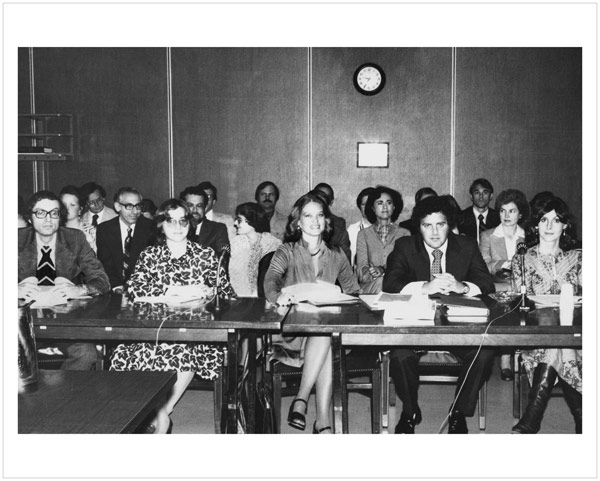
(front row) Peter Romeo, Ann Glickman, Janet Zimmer, Richard Nesson and Barbara Lucas; Roberta Karmel is in center in second row
(Courtesy of Richard Nesson )

Corporate practices converged to cause new challenges for the SEC in regulating takeovers. While the Securities Exchange Act of 1934 broadly mandated SEC jurisdiction in a wide variety of areas, that mandate was weak in areas of corporate governance and accounting practices.
American business experienced a wave of corporate mergers during the 1960s. The effect of mergers on the economy, on investors subject to the tender offers (offers made to purchase the stock of investors or a company in a merger or acquisition), and on the stability of the market, had never been fully studied by the SEC.
Unexpected economic events also played a role. In the 1960s, Penn Central Transportation Company and New York Central merged to form Penn Central Company. Later, it was revealed that the merger was merely a ploy to provide new borrowing power for Penn Central's acquisitions, using New York Central's greater liquid resources. At that time, the law did not require full and complete disclosure of the details of the merger to stockholders in either the acquiring or target company. In June 1970, Penn Central Company collapsed. Representing up to that time the largest bankruptcy in American history, the corporation left thousands of investors with worthless stock.
Congress had previously responded by passing the Williams Act in 1968, which required that bidders include all details of their tender offer, such as terms, cash source, and their plans for the company after the takeover, in their filing to the SEC and to the target company.
A SEC staff report detailed the causes of the Penn Central collapse, citing "stretching of accounting principles to cover novel situations, emphasizing form over substance on a number of major transactions"… and using subsidiaries to engage in what "were essentially paper transactions which should not have been recorded as profit."(22)
(22) The Financial Collapse of the Penn Central Company, Staff Report of the SEC to the Senate Special Committee on Investigations, (August 1972), 4.