William O. Douglas and the Growing Power of the SEC
The Chairmanship of William O. Douglas and the Battle on Wall Street
Related Museum Resources
![]() |
| Charles Gay |
The two previous SEC Chairmen, Joseph P. Kennedy and James L. Landis, had constructed the initial design of the administrative agency with an acute understanding of the pitfalls in making and administering regulatory policy.(1) During Kennedy’s tenure, the SEC had consolidated the New Deal legislative victory of the securities act. During Landis’s Chairmanship, the administrative machinery was established which the SEC would use to implement the mandate of the 1934 and 1935 Acts. Yet, despite the agency’s growth from 1934 to 1939, the SEC remained a work in progress. Douglas’s tenure as SEC Chairman would be to use the machinery his predecessors had created to make permanent its institutional authority over the nation’s stock markets.
The SEC continued its business as the national economy began a downturn in early 1937, but it faced an uncertain future. By October 19, 1937, when the bottom once again fell out of the stock market, the national economy was in full-blown recession. Millions of Americans lost their jobs and thousands of businesses went bankrupt. Opponents of the New Deal, especially the Wall Street old-guard led by Richard Whitney, blamed the SEC for the recession, arguing that its policies restricted the free flow of capital into the markets undermining the economy. Douglas became the voice of regulation on the Commission, giving numerous speeches denying that SEC regulation of the markets had hurt the economy. Despite heavy opposition to continued SEC involvement in regulating the national economy, Douglas continued to advise President Roosevelt on action the government should take to reform the economy.
Douglas’s SEC moment came when the rest of the New Deal was in fast retreat. Stock prices had fallen by 30% in the two months preceding his election as Chairman. More than six million Americans lost their jobs. Charles Gay, the president of the NYSE, commented on Douglas’s appointment, stating it "gratifying" and commended Douglas for "his experience and intimate knowledge of the problems that confront the securities markets," but blamed the SEC for amateurish regulation and interference with the process and flow of capital.(2)
Stung by the recession, President Roosevelt suggested a relaxation of margin requirements and the nomination of John W. Hanes, a member of the NYSE, to the SEC. Douglas acceded to Roosevelt’s suggestion to appoint a business insider, but got his friend Jerome Frank nominated to the Commission as a counterweight to Hanes.(3) When study of the stock exchanges which had been ordered during Joseph Kennedy’s tenure as Chairman was finally published in 1937, Douglas used the opportunity to push for major reforms. The receipt of the Kennedy Stock Exchange investigation report prompted Douglas to prepare for a battle to reform the country’s stock exchanges by regulating the activities of the exchanges in the interest of the investing public.
Despite the economic downturn, an October 1937 Gallup Poll reported that 62% of all investors and 69% of all voters thought that "Government regulation of the stock exchanges has helped investors."(4) Aware of the value of public support for the role of the SEC in the national economy, Douglas gave numerous public speeches advocating the position of the SEC. He criticized the NYSE for its clubby atmosphere and lack of control over insider trading. Putting his SEC experience as a staff member, Commissioner and now as Chairman, into action, Douglas advocated that the Exchange regulate itself, but insisted that it must do so by segregating broker/dealer functions and by establishing strong new reforms for its members.
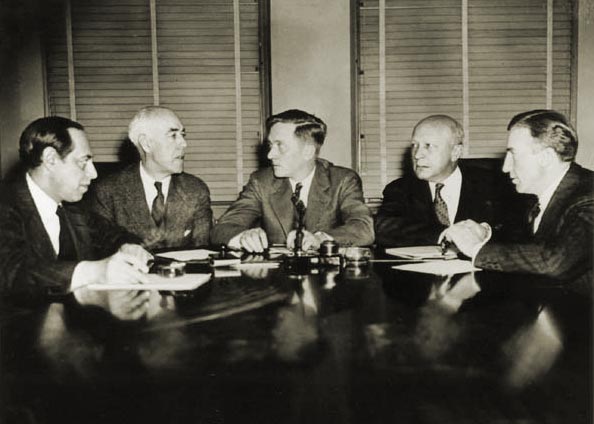
Yet, it soon became clear that the NYSE had its own internal conflicts. Inside the exchange, reform-minded members battled the old guard about working with the SEC to seek reorganization that would transform the NYSE from a private club into a modern, efficient organization. Douglas saw this division as an opportunity to push for reforms and called for a meeting between NYSE officials and the SEC. When Douglas, Gay and their negotiating teams met on November 19th for a final settlement attempt, the positions had so hardened that Douglas, responding to the NYSE’s proposed settlement, called off negotiations.
![]() |
| Richard Whitney |
Richard Whitney was a Wall Street icon. Long influential among the national business community, he had been one of the New Deal’s sharpest critics. Whitney, who epitomized the private club-like character of the stock exchange, chafed at Douglas’s calls for intervention. He led the internal opposition on the NYSE Board of Directors to the SEC Chairman’s demands for reform. Even as NYSE reformers like President Gay sought an agreement with Douglas, Whitney, who retained enormous power among the old guard of the NYSE, resisted.
Despite Whitney’s resistance, the SEC reached a tentative agreement with the NYSE over regulation, segregation of broker and of dealer activities, the handling of client accounts, and democratization of the NYSE Board of Directors. In addition, NYSE President Charles Gay would step down and be replaced by William Martin, of whom Douglas approved. But negotiations broke down over a proposal to create an outside paid president to run the Exchange. Douglas threatened to take outright government control of the Exchange, which was strongly resisted by Whitney. In February 1938, as the battle of Wall Street raged and the positions hardened, in a heated meeting between Stock Exchange Counsel William H. Jackson and Douglas, Jackson said, "Well, I suppose you’ll go ahead with your own program?"
Douglas replied, "You’re damned right I will."
"When you take over the Exchange," Jackson intoned, "I hope you’ll remember that we’ve been in business 150 years. There may be some things you will like to ask us."
"There is one thing I’d like to ask," Douglas replied.
"What is it?"
"Where do you keep the paper and pencils?"(5)
The battle on Wall Street continued from late October 1937 until February 1938. Douglas's bravado alone, however, would not be enough to force the reforms. Ironically, it would be Richard Whitney himself who would provide the political impetus that allowed Douglas to push his program ahead, and eventually win the full cooperation of the Exchange.
For years, Richard Whitney had been illegally using securities from his wife’s trust as collateral for loans from friends. Facing losing ventures, Whitney’s thirty-one different Wall Street loans totaling $8,284,000 came due in late 1937. Whitney sought help from other Wall Street insiders, including his brother George Whitney and George’s partner Charles Lamont, to bail him out. The men agreed to make the loan to Richard Whitney without advising their other partners.
![]() |
| William McC. Martin |
In every respect, the Whitney affair seemed to prove the need for reform of this "private club" that Douglas had been railing against. Douglas was unaware of Whitney’s troubles when he spoke to the New York Bond Club on January 7, 1938. His Bond Club address raised the stakes when he publicly notified Wall Street of the SEC’s plan to regulate the stock market with or without an agreement. Just two weeks later, the SEC issued a regulation requiring any short sell of a stock be made at a price higher than its most recent sale price. The unilateral imposition of the regulation on the stock market was the first in SEC history. Soon thereafter, facing the unilateral SEC moves, regional stock exchanges around the country began to reorganize themselves along the lines the SEC had recommended.
Despite Whitney’s troubles, he remained steadfastly and vocally opposed to any NYSE reforms. But on February 22, 1938, Whitney’s financial fraud was discovered by NYSE insiders. By March 7, the Governing Committee voted to press charges against Whitney. They notified Douglas, who immediately sensed that he had the political capital to force his reforms on Wall Street. The sight of Whitney, the Wall Street scion, pleading guilty in a New York courthouse to committing the kinds of insider acts Douglas and the SEC had been seeking to regulate dramatically strengthened Douglas’s position. By April 1938, 74% of Americans surveyed in a Gallup Poll believed that the Whitney affair proved the need for more SEC regulation of Wall Street.(6)
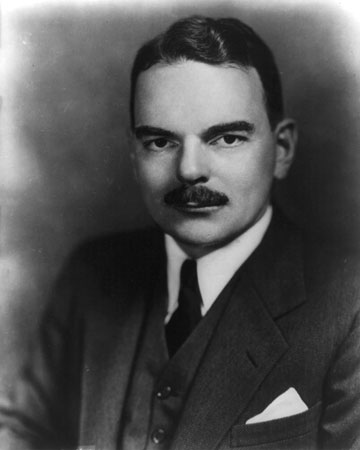
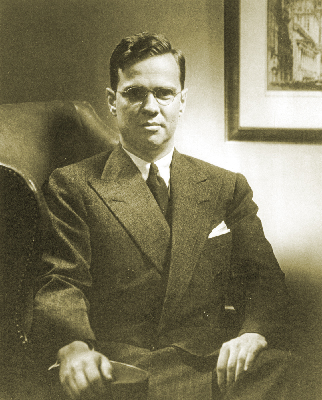
The Whitney bankruptcy and fraud was a national scandal, and Douglas immediately announced that the SEC would hold hearings. He requested that New York Prosecutor Thomas Dewey defer the final sentencing of Whitney until the SEC could call him before their investigation. On March 10, Whitney was indicted. The New York Stock Exchange expelled him on March 22, and shortly thereafter, agreed to adopt the reorganization measures including public representatives on the governing board, and a paid president and technical staff for the Exchange which had been proposed by the SEC. Douglas and new NYSE President William Martin held a series of round table discussions to work out the details, after which Douglas commented that his proposals were "all coming along like a horse race… You never know which will come in first."(7) But by then, the SEC had all the horses in the race. The battle on Wall Street had been won.
Related Museum Resources
Papers
Parts I and II of Statement of Richard Whitney on H.R. 7852, National Securities Act of 1934 [Image] (courtesy of the Library of Congress)
William O. Douglas, Margins and Markets, Response to Charles Gay, New York Stock Exchange (with permission of the Yale University Press)
Letter from William O. Douglas to Charles Gay, New York Stock Exchange [Transcription] (courtesy of the Library of Congress)
Notes from SEC Meeting on Broker-Dealer Segregation [Transcription] (courtesy of the Library of Congress)
Letter from William O. Douglas to Abe Fortas re Deposit Agreements v. Proxies [Transcription] (courtesy of the Library of Congress)
William O. Douglas, Lawyers and Conflicts of Interest, Talk before the Eastern Law Students Conference (with permission of the Yale University Press)
William O. Douglas, Investment Banking, Speech to The Bond Club of New York (with permission of the Yale University Press)
Letter from William O. Douglas to John T. Flynn [Transcription] (courtesy of the Library of Congress)
Letter from William O. Douglas to Morris Gutman, Lehman Brothers [Transcription] (courtesy of the Library of Congress)
Letter from William O. Douglas to Representative Jerry Voorhis [Transcription] (courtesy of the Library of Congress)
Letter from William O. Douglas to Edward H. Collins, The New York Herald Tribune [Transcription] (courtesy of the Library of Congress)
Letter from William O. Douglas to Ernest Angell, SEC Regional Administrator [Transcription] (courtesy of the Library of Congress)
Letter from William O. Douglas to Felix Frankfurter [Transcription] (courtesy of the Library of Congress)
Letter from the Chicago Stock Exchange to Harold Neff, SEC Forms and Regulation Division (courtesy of the National Archives)
Letter from Goldman, Sachs & Co. to Ganson Purcell, SEC Trading and Exchange Division (courtesy of the National Archives)
Letter from William O. Douglas to David Lilienthal, Tennessee Valley Authority [Transcription] (courtesy of the Library of Congress)
Memo from William O. Douglas to President Roosevelt re Over-the-Counter Brokers and Dealers [Transcription] (courtesy of the Library of Congress)
Letter from William O. Douglas to Dr. Herbert Feis, State Department [Transcription] (courtesy of the Library of Congress)
Letter from William O. Douglas to Representative Harry L. Englebright [Transcription] (courtesy of the Library of Congress)
Memo from William O. Douglas to President Roosevelt re Financial Problems of Small Businesses [Transcription] (courtesy of the Library of Congress)
Letter from William O. Douglas to Justice Hugo Black [Transcription] (courtesy of the Library of Congress)
Letter from William O. Douglas to Senator Francis T. Maloney [Transcription] (courtesy of the Library of Congress)
Letter from William O. Douglas to Walter Breslav [Transcription] (courtesy of the Library of Congress)
Telegram from William Bacon, San Francisco Stock Exchange, to Ganson Purcell, SEC (courtesy of the National Archives)
Letter from New York Stock Exchange to Ganson Purcell, SEC Trading and Exchange Division (courtesy of the National Archives)
Letter from William O. Douglas to Howard Buffett [Transcription] (courtesy of the Library of Congress)
Telegram from Lew Hahn, National Retail Dry Goods Association, to Harold Neff, SEC Division of Forms & Regulation [Image] (courtesy of the National Archives)
Telegram from Lew Hahn, National Retail Dry Goods Association, to Harold Neff, SEC Division of Forms & Regulation [Transcription] (courtesy of the National Archives)
Letter from William O. Douglas to Charles Gay, New York Stock Exchange [Transcription] (courtesy of the Library of Congress)
Letter from William O. Douglas to Wesley W. Stout, The Saturday Evening Post [Transcription] (courtesy of the Library of Congress)
Letter from William O. Douglas to James Roosevelt [Transcription] (courtesy of the Library of Congress)
Letter from Standard Stock Exchange to Day Karr, SEC (courtesy of the National Archives)
Letter from Representative Boileau to SEC Chairman Douglas (courtesy of the National Archives)
Memo from William O. Douglas to President Roosevelt re Federal Licensing Act for Corporations [Transcription] (courtesy of the Library of Congress)
Letter from William O. Douglas to Representative Gerald J. Boileau (courtesy of the National Archives)
Letter from Charlton Ogburn to SEC Chairman Douglas (courtesy of the National Archives)
Telegram from William O. Douglas to Thomas Dewey [Image] (courtesy of the Library of Congress)
Telegram from William O. Douglas to Thomas Dewey [Transcription] (courtesy of the Library of Congress)
Letter from William O. Douglas to Howland S. Davis, New York Stock Exchange [Transcription] (courtesy of the Library of Congress)
Letter from William O. Douglas to President Roosevelt [Transcription] (courtesy of the Library of Congress)
Letter from William O. Douglas to Charles Gay, New York Stock Exchange [Transcription] (courtesy of the Library of Congress)
Letter from William O. Douglas to Joseph P. Kennedy [Transcription] (courtesy of the Library of Congress)
Letter from William O. Douglas to the Secretary of State [Transcription] (courtesy of the Library of Congress)
Letter from Frederic Delano, National Resources Committee, to SEC Chairman Douglas (courtesy of the National Archives)
Letter from Felix Frankfurter to William O. Douglas (courtesy of the Library of Congress)
Letter from William O. Douglas to Felix Frankfurter [Transcription] (courtesy of the Library of Congress)
Letter from William O. Douglas to Representative Clarence Lea (courtesy of the National Archives)
Letter from Charles Gay, New York Stock Exchange, to Ganson Purcell, SEC Trading and Exchange Division (courtesy of the National Archives)
Letter from Felix Frankfurter to William O. Douglas (courtesy of the Library of Congress)
Letter from William O. Douglas to President Roosevelt, with letter to the Bureau of the Budget [Transcription] (courtesy of the Library of Congress)
Letter from William O. Douglas to President Roosevelt re SEC Commissioner George C. Mathews [Transcription] (courtesy of the Library of Congress)
Letter from William O. Douglas to Roswell Magill, Under Secretary of the Treasury [Transcription] (courtesy of the National Archives)
Memo from William O. Douglas re Willkie inquiry [Transcription] (courtesy of the Library of Congress)
Telegram from William O. Douglas to John G. Forrest for Charles Gay [Image] (courtesy of the Library of Congress)
Telegram from William O. Douglas to John G. Forrest for Charles Gay [Transcription] (courtesy of the Library of Congress)
Letter from William O. Douglas to Henry Morgenthau, Jr., Secretary of the Treasury [Transcription] (courtesy of the Library of Congress)
Letter from William O. Douglas to Julius Berens, Berens Financial News Bureau, Inc. [Transcription] (courtesy of the Library of Congress)
Memo from William O. Douglas to SEC Commissioner Jerome Frank [Transcription] (courtesy of the Library of Congress)
Letter from Cincinnati Stock Exchange to Ganson Purcell, SEC Trading and Exchange Division (courtesy of the National Archives)
Letter from Francis P. Brassor to Representative Robert L. Bacon [Transcription] (courtesy of the National Archives)
Letter from William O. Douglas to Marriner E. Eccles, Chairman, Board of Governors of Federal Reserve System [Transcription] (courtesy of the Library of Congress)
United States of America before the SEC in the Matter of Richard Whitney et al (courtesy of the National Archives)
Telegram from William O. Douglas to Francis E. Frothingham, Investment Bankers Association of America [Transcription] (courtesy of the Library of Congress)
Letter from Charles Eliot, National Resources Committee, to SEC Chairman Douglas (courtesy of the National Archives)
Letter from William O. Douglas to Joseph C. O'Mahoney [Transcription] (courtesy of the Library of Congress)
Letter from Association of Stock Exchange Firms to SEC Chairman Douglas (courtesy of the National Archives)
Letter from William O. Douglas to Representative Walter Chandler [Transcription] (courtesy of the Library of Congress)
Letter from William O. Douglas to Charles W. Eliot 2nd, National Resources Committee (courtesy of the National Archives)
Letter from William O. Douglas to SEC Commissioner Robert Healy on the Whitney Report [Transcription] (courtesy of the Library of Congress)
Letter from George Mathews to William Bacon, San Francisco Stock Exchange [Transcription] (courtesy of the Library of Congress)
Telegram from William O. Douglas to Robert M. Hutchins, University of Chicago [Transcription] (courtesy of the Library of Congress)
Telegram from William O. Douglas to William McC. Martin, New York Stock Exchange [Transcription] (courtesy of the Library of Congress)
Letter from Consumers Power Co. to Harold Neff, SEC Forms and Regulation (courtesy of the National Archives)
Memo from SEC Chairman Douglas re Associated Gas and Electric (courtesy of the Library of Congress)
Memo from William O. Douglas to Thomas Blaisdell [Transcription] (courtesy of the Library of Congress)
Letter from William O. Douglas to the Attorney General [Transcription] (courtesy of the National Archives)
Memo from Samuel O. Clark, Jr., Director, Reorganization Division, to William O. Douglas [Transcription] (courtesy of the National Archives)
Letter from William O. Douglas to Thomas Reed Powell, Harvard Law School [Transcription] (courtesy of the Library of Congress)
Letter from Representative A.J. Sabath to Thomas Corcoran re Joseph L. Tupy (courtesy of the Library of Congress)
Memo from William O. Douglas to Chester Lane [Transcription] (courtesy of the Library of Congress)
Letter from William O. Douglas to George E. Bates, Harvard University [Transcription] (courtesy of the Library of Congress)
Memories from Early Days of the Securities and Exchange Commission, by Karl C. Smeltzer (prepared for the museum by Karl Smeltzer)
Photos
- Gay, Charles (1935) (Courtesy of New York Stock Exchange)
- Dewey, Thomas E. (1938) (Courtesy of the Harris & Ewing Collection, Library of Congress)
- SEC Commission (1938) (Courtesy of David Ginsburg)
- William McM. Martin (1938) (Courtesy of New York Stock Exchange)
- SEC Commission (1938-39)
- SEC Women's Bowling League (1939) (Photo and identification courtesy of Francis J. Trainor)
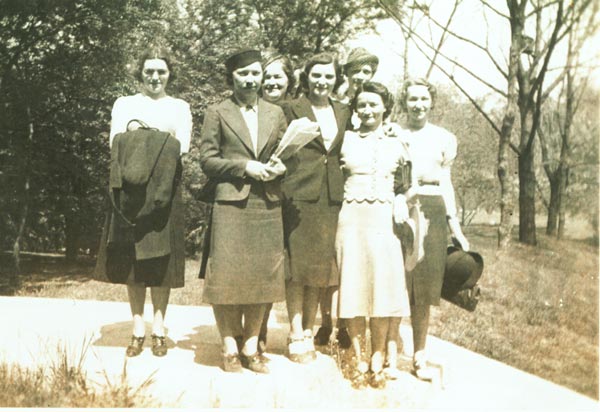
- SEC Public Utility Division Female Staff (Spring 1939) (Photo and identification courtesy of Francis J. Trainor)
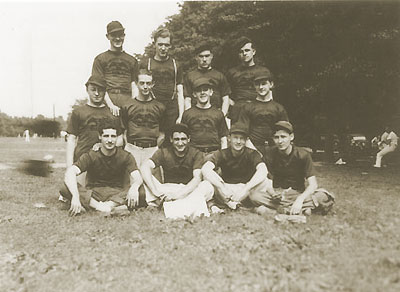
- SEC Messenger Softball Team (June 1939) (Photo and identification courtesy of Francis J. Trainor)
Oral Histories
- Jack Ferguson Interview
- Lawrence Greene Interview
- Bernard Meltzer Interview
- Francis Trainor Interview
Movie Clip
- Hearst Metrotone News: "Sing Sing’s Gates Close on Richard Whitney"
(courtesy of UCLA Film and Television Archives)
Footnotes:
(1) Thomas K. McCraw, Prophets of Regulation (Cambridge: Belknap Press, 1984), Chapter 5.
(2) "Douglas Is Named Chairman of SEC," New York Times, September 22, 1937, p.41.
(4) "Stock Owners Call Commission Helpful," The Washington Post, October 17, 1937, B1.
(5) Bruce Allen Murphy, Wild Bill: The Legend and Life of William O. Douglas ( New York: Random House, 2003), 140-154, 144.
(6) "The Gallup Poll: Whitney Affair Found to Be Influencing Public View of Wall Street Regulation," The Washington Post, April 13, 1938, X2.
(7) "SEC ‘Crack-Downs’ Over, Douglas Says," The New York Times, June 4, 1938, p. 1.